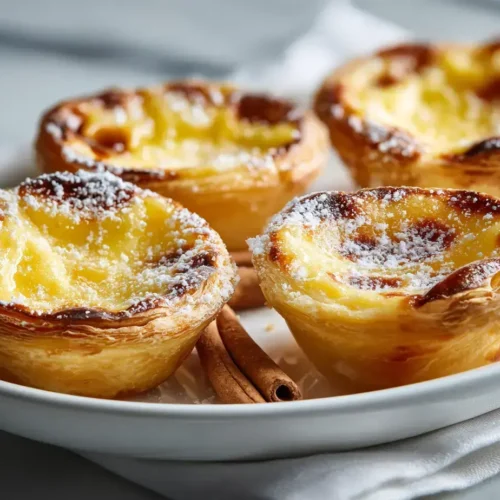
These Portuguese custard tarts bring the magic of Lisbon’s bakeries right to your kitchen, with flaky puff pastry cups filled with a silky, cinnamon-kissed custard. My version uses a simplified method for achieving those signature caramelized leopard spots without special equipment. They’re perfect for a weekend baking project or an elegant finish to a special meal.

I first fell in love with these tarts during a misty morning in Belém, the steam from my espresso curling around the warm, crisp pastry. That experience inspired me to recreate the magic at home, achieving that delicate balance of creamy custard and shatteringly crisp shells. Now, I love serving them alongside a pot of fragrant tea for a cozy afternoon treat or as the star dessert after a dinner featuring my rich flan or a slice of coconut cream pie. They transform any moment into a small celebration.
Four Reasons to Bake Pasteis de Nata
- Authentic Flavor Profile: The lemon-cinnamon syrup creates a custard with genuine Portuguese bakery character.
- Impressive Yet Approachable: Using puff pastry simplifies the process while delivering professional-looking results.
- Perfect Make-Ahead Dessert: You can prepare the components ahead for easy assembly and baking.
- Crowd-Pleasing Elegance: Their beautiful appearance and delightful taste make them a guaranteed hit.
What You’ll Need for Perfect Portuguese Custard Tarts
Be sure to see the recipe card below for the full listing of ingredients, instructions, notes, and estimated nutritional information.
- Puff Pastry: One sheet, chilled, creates the essential flaky, layered crust.
- Granulated Sugar: Forms the base of the flavor-infusing syrup.
- Water: Combines with sugar to create the syrup’s liquid component.
- Lemon Peel: A single strip adds a bright, citrusy fragrance to the custard.
- Cinnamon Stick: Infuses the syrup with warm, authentic spice notes.
- Whole Milk: Provides the rich, creamy base for a luxurious custard texture.
- Large Egg Yolks: Six yolks give the filling its vibrant color and silky structure.
- All-Purpose Flour: A small amount acts as a stabilizer for the custard.
- Salt: A pinch enhances all the other flavors in the tart.
Portuguese Custard Tarts
Learn to make authentic Portuguese custard tarts with this easy recipe. Perfect flaky pastry and creamy custard with signature caramelized tops in under 2 hours.
Prep Time 45 minutes mins
Cook Time 18 minutes mins
50 minutes mins
Total Time 1 hour hr 53 minutes mins
Course Dessert
Cuisine Portuguese
Servings 12 tarts
Calories 280 kcal
mixing bowl
knife
cutting board
measuring cups
measuring spoons
saucepan
whisk
fine-mesh sieve
muffin tin
oven
Pastry
- 1 sheet puff pastry about 14 ounces, unrolled and chilled
Sugar Syrup
- 1 cup granulated sugar
- 3/4 cup water
- 1 strip lemon peel from 1/2 large lemon
- 1 cinnamon stick about 3 inches long
Custard
- 1 1/2 cups whole milk
- 6 large egg yolks
- 2 tablespoons all-purpose flour
- 1/4 teaspoon salt
Unroll the puff pastry sheet on a lightly floured surface. Tightly roll it up from one of the short ends into a log. Using a sharp knife, cut the log into 12 equal slices, each about 1 1/4 inches thick. Place each pastry slice, cut-side down, into a standard 12-cup muffin tin. Using your thumbs, press the pastry out from the center to form a thin cup that lines the entire cavity, ensuring the bottom is very thin and the sides are slightly thicker and extend to the top rim of the cup. Refrigerate the muffin tin while you prepare the custard.
In a small saucepan, combine 1 cup granulated sugar, 3/4 cup water, the 1 strip of lemon peel, and the 1 cinnamon stick. Bring the mixture to a rolling boil over medium-high heat, stirring occasionally until the sugar is fully dissolved. Once boiling, reduce the heat to medium and continue to simmer for exactly 3 minutes without stirring. Remove the saucepan from the heat and let the syrup cool slightly for 5 to 10 minutes. Discard the lemon peel and cinnamon stick.
In a separate medium saucepan, whisk together 1 1/2 cups whole milk, 2 tablespoons all-purpose flour, and 1/4 teaspoon salt until the mixture is smooth and lump-free. Cook this mixture over medium heat, stirring constantly with a whisk, until it thickens to a pourable custard consistency, similar to a thin pudding, about 5 to 7 minutes. The mixture should be thick enough to coat the back of a spoon. Remove from heat.
In a medium heatproof bowl, lightly whisk the 6 large egg yolks until just combined. Slowly pour about half of the warm milk mixture into the egg yolks, whisking constantly and vigorously to temper them. This crucial step gradually brings the egg yolks up to temperature, preventing them from scrambling. Pour the tempered egg mixture back into the remaining milk mixture in the saucepan, whisking until thoroughly combined.
Gradually pour the slightly cooled sugar syrup into the egg yolk and milk mixture, whisking constantly until the custard is smooth and well-integrated. For a silky-smooth texture, strain the entire custard mixture through a fine-mesh sieve into a clean bowl to remove any potential lumps or bits of cooked egg.
Preheat your oven to 500 degrees Fahrenheit (260 degrees Celsius). Remove the chilled pastry-lined muffin tin from the refrigerator. Carefully fill each pastry cup about three-quarters full with the strained custard. Do not overfill.
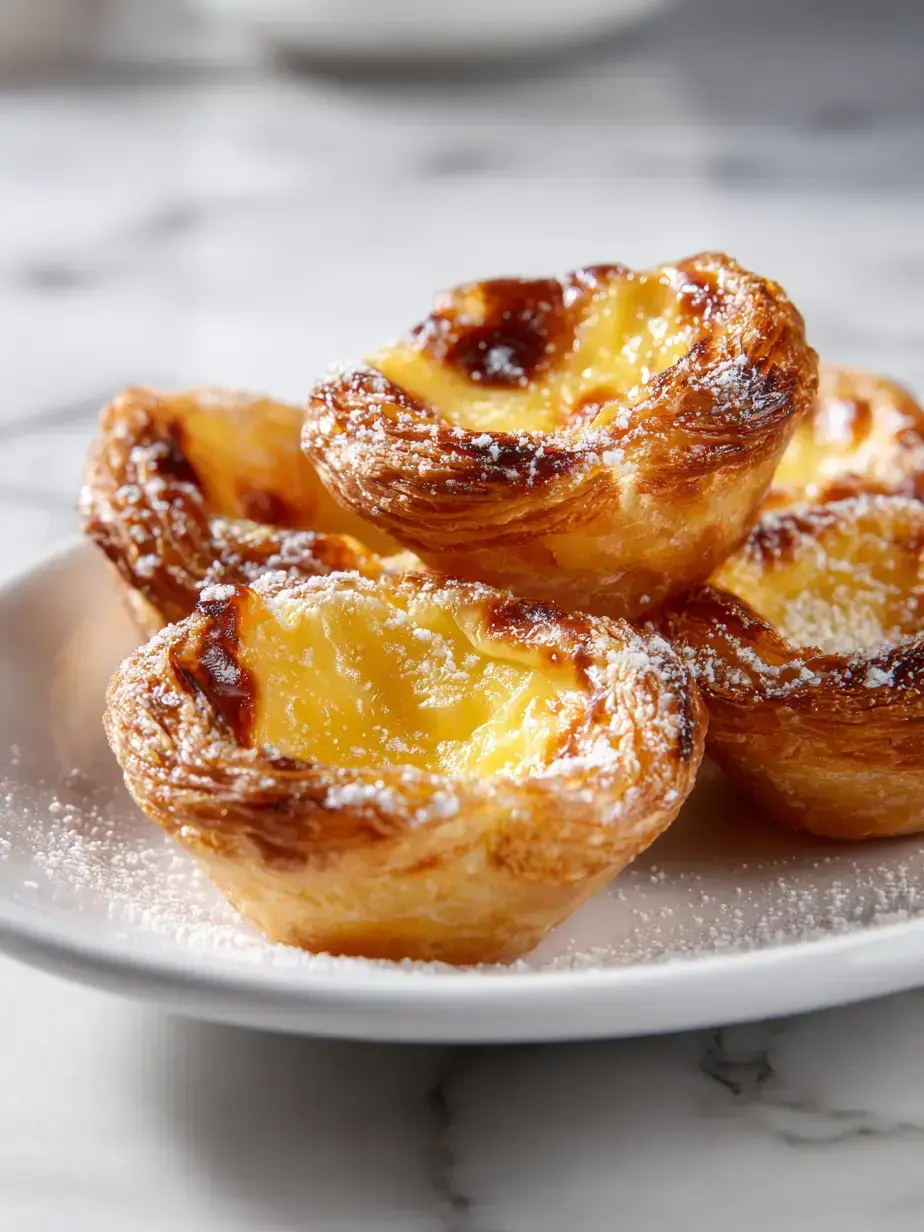
Transfer the muffin tin to the preheated oven. Bake for 15 to 20 minutes, or until the pastry is deeply golden brown and flaky, and the custard is visibly bubbly with characteristic dark brown or almost black “leopard spots” on top. These spots are highly desirable and indicate proper caramelization. Keep a close eye on the tarts during the last few minutes of baking to prevent burning.
Carefully remove the hot tarts from the oven. Let them cool in the muffin tin for 5 to 10 minutes to allow them to set slightly before gently transferring them to a wire rack to cool completely. Portuguese custard tarts are traditionally enjoyed warm or at room temperature, ideally on the same day they are baked for the best flavor and texture.
Portuguese custard tarts are traditionally enjoyed warm or at room temperature, ideally on the same day they are baked for the best flavor and texture.
Keyword baking, custard tarts, pastry
Creative Recipe Variations
- Citrus Twist: Replace the lemon peel with an orange peel for a sweeter, warmer citrus note.
- Spiced Custard: Add a tiny pinch of nutmeg or cardamom to the milk mixture for extra warmth.
- Mini Tarts: Use a mini muffin tin for bite-sized versions perfect for parties.
My Pro Tips for Perfect Pasteis
- Chill the Pastry Thoroughly: A well-chilled pastry log is much easier to slice cleanly and press into the tin.
- Thin Bottoms are Key: When pressing the pastry, ensure the bottom is thinner than the sides to avoid a doughy base.
- Master the Temper: Slowly stream the warm milk into the yolks while whisking constantly to create a smooth custard. This technique is similar to what creates the silky texture in a classic Boston cream pie.
- Embrace the Spots: The dark caramelized spots are a sign of perfect baking, so don’t be alarmed.
How to Store Your Custard Tarts
- Store: Keep cooled tarts in an airtight container in the refrigerator for up to 3 days. The pastry will soften.
- Freeze: Freeze fully cooled tarts in a single layer on a baking sheet before transferring to a freezer bag for up to 1 month.
- Reheat: Revive the crispness by reheating frozen or refrigerated tarts in a 350°F oven for 8-10 minutes.
- Make-Ahead Tip: The custard can be made up to 2 days ahead and stored covered in the fridge.
Frequently Asked Questions
What is the difference between Portuguese custard tarts and English custard tarts?
Portuguese custard tarts, or pasteis de nata, are characterized by their crispy, flaky puff pastry shell and custard that is caramelized on top from very high-heat baking. English custard tarts typically use a shortcrust pastry and are baked at a lower temperature, resulting in a softer pastry and a pale, creamy top without the signature spots.
Why are my Portuguese egg tarts soggy?
Sogginess is often caused by underbaking or filling the pastry cups while they are not sufficiently chilled. Ensure your pastry is well-chilled before adding the custard, and bake at the high temperature specified until the tops are spotted and bubbly. This high heat is crucial for setting the custard quickly and keeping the pastry crisp.
Can I use phyllo dough instead of puff pastry for Portuguese tarts?
While puff pastry is traditional for its flaky, buttery layers, phyllo dough can be used as a substitute for a different, crackly-thin texture. You would need to layer and butter several sheets of phyllo, then roll and slice it similarly to the puff pastry method. The result will be less rich but still deliciously crisp.
How do you get the black spots on Portuguese tarts?
The iconic black spots, or “burn marks,” are achieved by baking the tarts in an extremely hot oven, around 500°F (260°C). The high heat causes the sugar in the custard to caramelize quickly on the surface before the rest of the tart overcooks. This is a hallmark of an authentic pastel de nata.
More Irresistible Desserts to Try
Why This Portuguese Custard Tart Recipe Works
The combination of a clever puff pastry shortcut and the authentic infused custard delivers an incredible dessert with minimal fuss. I love how the high-heat bake creates that signature caramelized top and flaky crust simultaneously. They are truly a special treat that will impress your family and guests with their beautiful presentation and unforgettable taste.